 Check
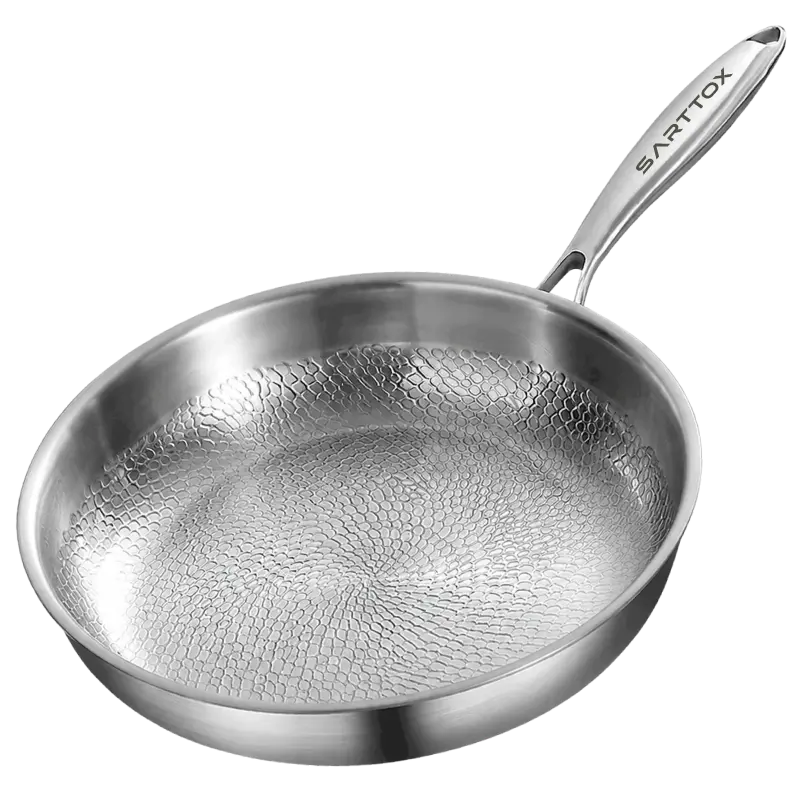
Titanium frying pans are everywhere in UK adverts, usually with promises of "non-toxic" cooking and pans that last forever. The word "titanium" on the box, though, can describe very different pans. Knowing which type you're buying is the key to being happy with it.
The 3 types of titanium frying pan
1. Titanium-reinforced non-stick
The most common type. A PTFE (Teflon-type) non-stick coating with titanium particles added for durability. Very non-stick, but it's still a coating that can wear and shouldn't be overheated.
2. Solid titanium
Light and popular for camping. It heats unevenly, has hot spots and isn't magnetic, so it won't work on induction.
3. Titanium surface on stainless steel
A titanium cooking surface, often with a raised honeycomb pattern, bonded to a multi-layer stainless steel body. No classic non-stick coating, even heat and induction-ready. The Qinux Sarttox belongs here.
Are titanium pans safe? PTFE and PFAS explained
Titanium itself is inert. The safety questions are really about PTFE, the non-stick coating used in many pans, which belongs to the PFAS family of "forever chemicals". PFOA, a chemical once used to make PTFE, is no longer used in the UK.
Food safety authorities say that PTFE pans used as intended are not expected to harm health. The problem is overheating: above about 260°C, PTFE can start to release fumes. So with any coated pan, don't heat it empty on full power and replace it once the coating is scratched or flaking.
Sources: German Federal Institute for Risk Assessment (BfR), Q&A on PTFE-coated cookware; Singapore Food Agency, safe practices for non-stick pans.
A titanium-on-stainless pan without classic non-stick coating side-steps the coating question entirely. Note that marketing words like "non-toxic" are the manufacturer's own claims.
Read the full Qinux Sarttox Frying Pan ReviewMaterials, induction, cleaning and our verdict on the Qinux SarttoxTitanium vs non-stick vs stainless vs cast iron
| Feature | Titanium on stainless | PTFE non-stick | Plain stainless | Cast iron |
|---|---|---|---|---|
| Classic coating | None | Yes (PTFE) | None | None (seasoning) |
| Food release | Good if preheated | Excellent | Sticks easily | Good once seasoned |
| Lifespan | Long | A few years | Long | Very long |
| Metal utensils | Yes | No | Yes | Yes |
| Induction | Yes | Depends on base | Yes | Yes |
| Weight | Medium | Light | Medium | Heavy |
How to cook in a titanium pan without sticking
- Preheat on medium for 2 to 3 minutes. A drop of water should dance across the surface.
- Add a little oil or butter – it settles into the honeycomb and helps food release.
- Let food sear and release on its own before turning it.
- Medium heat is enough: the stainless steel body holds heat well.
- Clean while warm with hot water and a brush; soak stubborn bits briefly.
Where the Qinux Sarttox fits
The Sarttox is a 30 cm pan with a titanium honeycomb cooking surface on a multi-layer stainless steel body. According to the manufacturer it works on induction, gas and ceramic hobs and does without a conventional non-stick layer. It's not a "slide-off" egg pan like fresh PTFE – but used with a preheat and a little fat, it sticks far less than plain stainless steel and won't flake.
FAQ: titanium frying pans
Verdict: worth it – if "titanium" means a titanium surface
Check what the word means before you buy. A titanium-reinforced non-stick pan is still a PTFE pan. A titanium surface on stainless steel, like the Qinux Sarttox, has no coating to wear off, works on induction and lasts. Preheat it, use a little fat, and it's an easy upgrade from a scratched non-stick pan.
→ Visit the official Sarttox website *